
WPI-8 Texas Home Insurance: What the Windstorm Inspection Form Means for Your Policy
WPI-8 is the Texas windstorm inspection form required for coastal home insurance. Learn what inspectors check, how it affects your premium, and when you need one.
12 minute read. Published November 16, 2026. By Alongside Insurance.
The short version
- A WPI-8 is the Texas Department of Insurance windstorm inspection certificate that documents a coastal home's compliance with building code wind-resistance standards required for windstorm coverage.
- Coastal homeowners need a WPI-8 because insurers require proof that a home meets wind-resistance standards before issuing or renewing windstorm coverage through TWIA or a private carrier.
- WPI-8 inspections are required in Texas's designated catastrophe area, which includes multiple coastal counties and portions of additional inland counties where windstorm coverage is written separately.
- A WPI-8 inspector checks roof covering and attachment, roof-deck fastening, roof-to-wall connections, wall-to-foundation connections, opening protections, and gable-end bracing against wind uplift and lateral forces.
- Only TDI-appointed windstorm inspectors or appointed Texas-licensed professional engineers can perform WPI-8 inspections and sign the certificate of compliance.
What Is a WPI-8 Form in Texas?
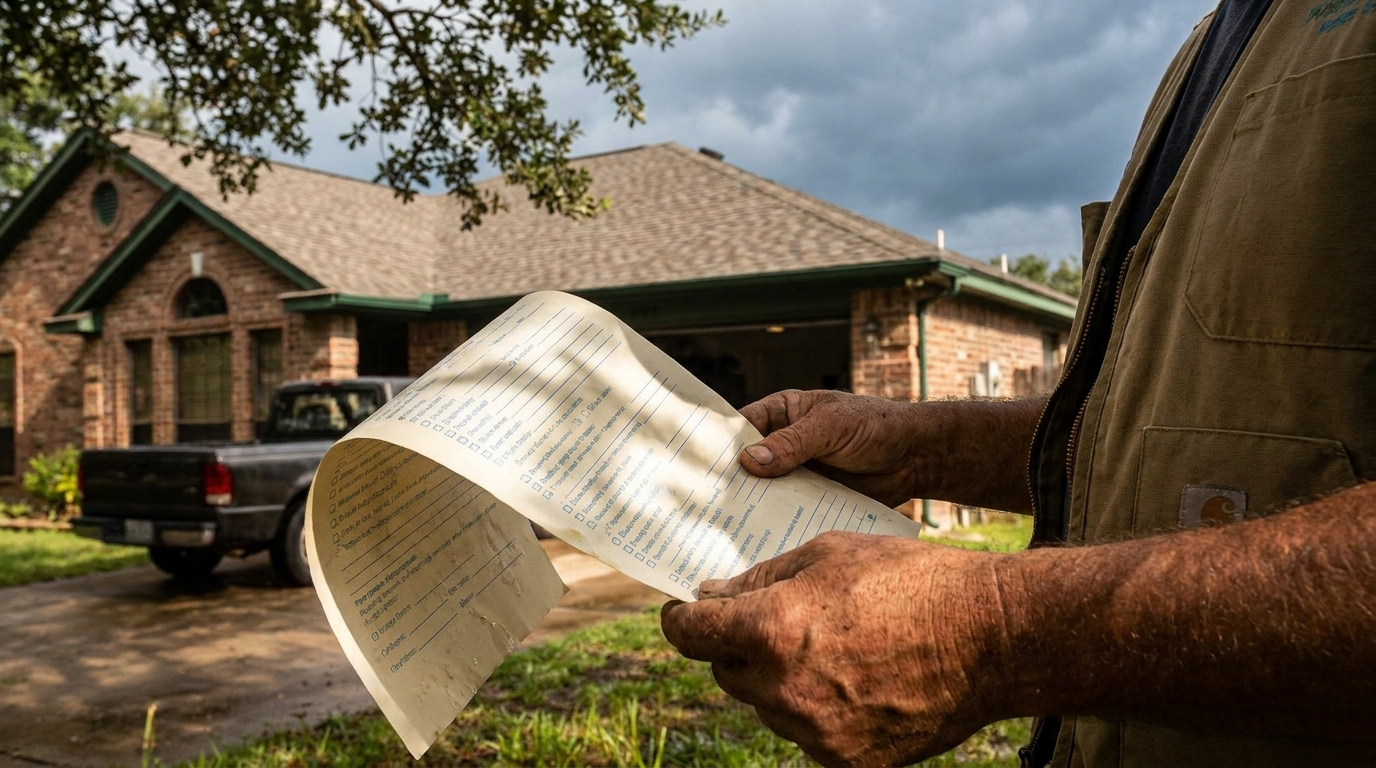
A WPI-8 is the Texas Department of Insurance windstorm inspection certificate that documents a coastal home’s compliance with building code wind-resistance standards required for windstorm coverage.
If you own a home in one of Texas’s designated coastal counties, the term WPI 8 will come up the moment you apply for wind and hail insurance. The letters stand for “Windstorm and Hail Insurance, Windstorm Inspection,” and the form itself is a Certificate of Compliance issued by TDI after an appointed inspector verifies that your home’s construction meets the state’s windstorm building code. TDI issues two types of certificates of compliance: a WPI-8 for ongoing construction and a WPI-8E for completed construction. If construction is already finished, a completed-construction certificate may be sought through a WPI-8E, because a completed structure is harder to inspect for code compliance. [Source: Texas Department of Insurance]
The requirement applies to structures built, altered, or repaired with construction starting on or after January 1, 1988 in designated catastrophe areas. Without a valid WPI-8, the property is generally ineligible for wind and hail coverage through the Texas Windstorm Insurance Association (TWIA). [Source: TDI Inspection Process]
Think of the WPI-8 as a building permit’s cousin focused entirely on wind resistance. It doesn’t cover plumbing, electrical, or HVAC. It covers how well your roof, walls, foundation, and openings hold together when a hurricane pushes against them.
Why Do Texas Coastal Homeowners Need a WPI-8?
Coastal homeowners need a WPI-8 because insurers require proof that a home meets wind-resistance standards before issuing or renewing windstorm coverage through TWIA or a private carrier.
Standard homeowners insurance policies in Texas typically exclude wind and hail damage in the designated coastal territory. That means you need a separate windstorm policy, and the WPI-8 is the entry ticket. TDI created the inspection program so that every insured coastal structure meets a minimum engineering standard. The logic is straightforward: if a home can’t withstand the wind speeds common to the Gulf Coast, insuring it for wind damage creates a predictable loss.
The certificate protects you, too. A home that passes the WPI-8 has verified connections from roof to wall to foundation, proper roof-deck attachment, and code-compliant opening protections. Those features reduce the chance of catastrophic damage during a storm, which means fewer claims and a more stable insurance market for everyone in the territory.
Which Texas Counties Require a WPI-8 Inspection?
WPI-8 inspections are required in Texas’s designated catastrophe area, which includes multiple coastal counties and portions of additional inland counties where windstorm coverage is written separately.
Designated Catastrophe Area and Seacoast Territory
TDI defines a designated catastrophe area that encompasses full coastal counties as well as “seacoast territory” portions of certain inland counties. The distinction matters because your specific address, not just your county, determines whether you need a WPI-8.
If your home sits in the seacoast territory of an inland county, you’ll need a separate windstorm policy and a WPI-8 just like someone in Galveston. If your home is outside the seacoast territory in the same county, standard homeowners coverage typically includes wind. Your agent or TDI can confirm whether your specific address falls inside the designated area.
Does Harris County Require a WPI-8?
Parts of Harris County do fall within the designated seacoast territory. If your address falls within that territory, your standard homeowners policy excludes wind and hail, and you’ll need a WPI-8 to obtain TWIA windstorm coverage or a private windstorm policy. Your agent or TDI can confirm whether your specific address is inside the designated area.
What Does a Windstorm Inspector Check on a WPI-8?
A WPI-8 inspector checks roof covering and attachment, roof-deck fastening, roof-to-wall connections, wall-to-foundation connections, opening protections, and gable-end bracing against wind uplift and lateral forces.
The inspection verification form requires the inspector to document the design wind speed in miles per hour (using the 3-second gust method), the risk category (I through IV), the exposure category (B, C, or D), and the code or standard used, such as the International Residential Code 2024, ASCE 7, or ICC 600. [Source: TDI]
Roof Covering and Attachment
The inspector verifies that roof products have at least 110 mph wind resistance and have been tested to ASTM D 3161. [Source: TDI] This means your shingles, tiles, or metal panels need to be rated for the design wind speed at your location and installed according to the manufacturer’s specifications.
Roof Deck Attachment
Plywood or OSB panels must be fastened to the trusses or rafters with the correct nail size, spacing, and pattern specified by the building code. The inspector checks nailing schedules at edges and in the field of each panel. If you’re having a re-roof or re-decking done, this is one of the items the inspector needs to see while the work is underway.
Roof-to-Wall Connections
TDI’s contractor guidance highlights that inspectors verify secure roof-to-wall, floor-to-floor, and wall-to-foundation connections, including hurricane clips. [Source: TDI] Hurricane clips or straps tie the roof trusses to the top plate of the wall. Without them, wind uplift can peel the roof off the walls even if every shingle is intact.
Opening Protections
Windows, doors, skylights, and garage doors in the windstorm territory may need to be impact-resistant or protected by rated shutters. TDI notes that impact-resistant windows should be tested to ASTM E 1886 or ASTM E 1996. [Source: TDI] If your home has standard glass without shutters, this is a common deficiency.
Gable-End Bracing
Gable-end walls are particularly vulnerable to lateral wind pressure. The inspector checks for diagonal bracing that prevents the gable from collapsing inward or outward. Older homes built before modern wind codes often lack this bracing entirely, making it one of the most frequent items flagged during a WPI-8 inspection.
TDI also notes that some work does not require a windstorm inspection: roof repairs under 100 square feet that do not involve decking, painting, carpeting, cabinets, fences, gutters, decorative shutters, steps, screen doors, and plumbing or electrical repairs. [Source: TDI]
Who Can Perform a WPI-8 Inspection in Texas?
Only TDI-appointed windstorm inspectors or appointed Texas-licensed professional engineers can perform WPI-8 inspections and sign the certificate of compliance.
For ongoing construction, the inspection can be done by either a TDI windstorm inspector or an appointed Texas-licensed professional engineer. If the construction is already completed, only a Texas-licensed professional engineer can perform the inspection for a completed-construction certificate (WPI-8E). [Source: TDI]
Texas rules require appointed qualified inspectors to demonstrate experience and education related to windstorm design and to provide their Texas Board of Professional Engineers and Land Surveyors registration number. [Source: TDI] Only appointed qualified inspectors, their staff, and TDI employees can log in to TDI’s Windstorm System to submit certificates. [Source: TDI]
You hire the inspector directly. Alongside Insurance does not schedule or perform inspections. Your roofer or contractor may recommend an inspector they’ve worked with, but the inspector must be independent and cannot have a financial interest in the repairs.
How Much Does a WPI-8 Inspection Cost?
A WPI-8 inspection usually costs anywhere from about $100 to $800, though TDI inspectors charge nothing and private engineer fees vary by project size and complexity.
TDI does not charge an inspection fee for its own inspectors and does not regulate or track private engineer rates. [Source: TDI] That said, TDI inspectors have limited availability, especially after major storms, so many homeowners hire a private engineer.
| Inspection Type | Typical Cost Range | Notes |
|---|---|---|
| TDI inspector (ongoing construction) | $0 | No fee, but availability may be limited |
| Private engineer (ongoing construction) | $100 to $500 | Varies by property size and location |
| Private engineer (completed construction / WPI-8E) | $500 to $800+ | Higher because verifying finished work is more difficult |
| Full engineering evaluation package | $795 to $3,000+ | Some firms bundle evaluation, report, and certification |
TDI states that inspecting a completed structure is more difficult and may cost more than inspecting work during construction. [Source: TDI] The practical lesson: if you’re replacing your roof or making structural repairs, schedule the WPI-8 inspection while the work is in progress. You’ll have more inspector options and likely pay less.
When Do You Need a New WPI-8?
You need a new WPI-8 when buying a coastal home without an existing certificate, after roof replacement or structural repairs, or when your insurer requests one at renewal.
The WPI-8 requirement applies to structures built, altered, or repaired with construction starting on or after January 1, 1988. [Source: TDI] If your home was built before that date and has never been altered, you may not need one, but your insurer can still request an inspection at renewal, especially if the home has had wind or hail claims.
After a full roof replacement, you’ll need a new WPI-8 because the roof-deck attachment, roof covering, and roof-to-wall connections have all changed. The same applies to structural additions, re-decking, and retrofitting exterior openings.
What Happens If Your Home Fails the WPI-8 Inspection?
If your home fails, the inspector posts a notice describing the deficiencies, and TDI will not issue the certificate until you complete repairs and pass a re-inspection.
TDI is clear on this point: “If the structure does not comply, the TDI inspector will post a notice at the job describing the problems.” A TDI inspector will return to the site for a re-inspection after the problems have been corrected. [Source: TDI] If TDI determines that a structure does not meet windstorm building code standards, TDI will not issue a Form WPI-8. TDI may also rescind a WPI-8 already issued if the structure is later found noncompliant. [Source: TDI]
Without a valid WPI-8, the property is generally ineligible for wind and hail coverage through TWIA, which is the key insurance consequence for many coastal homes.
Common WPI-8 Deficiencies
The deficiencies that come up most often in older coastal homes include missing or inadequate hurricane clips at roof-to-wall connections, improper roof-deck nailing patterns, unprotected openings (standard glass windows without shutters or impact rating), missing gable-end bracing, and roof products that don’t meet the 110 mph wind-resistance requirement.
Worked example (hypothetical): A homeowner in Galveston has a home built in 2005 with the original roof. At renewal, the windstorm carrier requests a WPI-8. The homeowner hires a private engineer for about $400. The inspector finds that the gable ends lack diagonal bracing and that two garage-door panels are not rated for the design wind speed. The homeowner hires a contractor to install gable-end bracing (roughly $1,500) and replace the garage-door panels with wind-rated units (roughly $2,000). After the repairs, the engineer returns for a re-inspection, confirms compliance, and submits the documentation to TDI. TDI processes the WPI-8 within about three working days. [Source: TDI] The homeowner’s windstorm policy renews.
How Long Do You Have to Make Repairs?
TDI doesn’t publish a fixed deadline for completing repairs after a failed inspection. In practice, the timeline depends on your policy renewal date. If your windstorm policy is up for renewal in 60 days and the inspection turns up deficiencies, you need to complete repairs and pass re-inspection before that renewal date. Talk to your agent early so you have time to schedule contractors and the re-inspection.
One important nuance: TWIA’s guidelines note that some owners of one- or two-family dwellings with missing certificates for work begun on or after January 1, 1988 but before June 19, 2009 may be eligible for a waiver, though the waiver comes with a surcharge noted on the policy declarations page. [Source: TDI]
Is a WPI-8 the Same as a 1802 Inspection?
No. A WPI-8 is a Texas windstorm compliance certificate, while a “1802 inspection” refers to Florida’s OIR-B1-1802 wind mitigation form. They are different programs in different states.
The WPI-8 is issued by a TDI-appointed inspector and determines whether a Texas coastal home meets windstorm building code requirements for TWIA eligibility. Florida’s 1802 form is completed by a Florida-licensed inspector and is used to document wind mitigation features for insurance premium discounts. According to Pella, Florida’s report is typically valid for five years. [Source: Pella]
| Item | WPI-8 (Texas) | 1802 Inspection (Florida) |
|---|---|---|
| State | Texas | Florida |
| Purpose | Certificate of compliance for windstorm eligibility | Wind mitigation documentation for insurance discounts |
| Who performs it | TDI-appointed inspector or appointed Texas-licensed professional engineer | Florida-licensed inspector, contractor, engineer, architect, or certified wind mitigation inspector |
| Main insurance use | TWIA wind/hail coverage eligibility | Premium discounts and mitigation credits |
| Typical timing | During construction or as part of code compliance documentation | Usually after construction, for existing-home mitigation review |
Texas homeowners sometimes confuse the two because both involve wind-resistance inspections. If you’re in Texas, the form you need is the WPI-8 (or WPI-8E for completed construction). The 1802 does not apply here.
Some Texas homeowners also confuse the WPI-8 with a general property condition inspection, sometimes called a “four-point inspection,” that checks plumbing, electrical, HVAC, and roof condition for standard homeowners insurance on older homes. That’s a different report entirely. The WPI-8 focuses exclusively on wind-resistance features and is specific to the designated coastal counties.
Do You Need a WPI-8 for TWIA Coverage?
Yes. TWIA requires a valid WPI-8 or WPI-8E for structures in the designated catastrophe area that were built, altered, or repaired with construction starting on or after January 1, 1988.
TWIA is the insurer of last resort for wind and hail coverage in the coastal counties. If no private carrier will write your windstorm policy, TWIA will, but only if the property has a valid Certificate of Compliance. TWIA may also inspect properties using vendors or aerial imagery to verify insurability and rating information. [Source: TDI]
Private windstorm carriers operating in the coastal territory often accept a valid WPI-8 as well, though each carrier sets its own underwriting requirements. Having a current WPI-8 on file gives you more options when shopping for wind and hail deductibles and coverage terms.
Passing the WPI-8 does not mean you’ll receive a specific rate or that any carrier is obligated to offer you a policy. It’s a minimum compliance requirement, not a pricing tool.
Frequently Asked Questions
How long does a WPI-8 inspection take?
The on-site inspection itself typically takes one to three hours depending on the size and complexity of the home. After the inspector submits documentation, TDI says to allow about three working days for processing before the certificate is posted online. [Source: TDI]
Can I look up whether my home already has a WPI-8?
Yes. TDI’s Windstorm System allows anyone to locate, view, and print certificates. [Source: TDI] Check there before hiring an inspector. If your home already has a valid WPI-8 and you haven’t made structural changes, you may not need a new one.
What is the difference between a WPI-8 and a WPI-8E?
A WPI-8 is issued for ongoing construction, where the inspector can observe the work in progress. A WPI-8E is for completed construction, where the work is already finished. Completed-construction inspections are harder to verify and typically cost more. [Source: TDI]
Does a WPI-8 expire?
TDI does not publish a fixed expiration date for a WPI-8. However, the certificate applies to the construction it was issued for. If you replace the roof, add a room, or make structural repairs, you’ll need a new WPI-8 for that work.
Will my windstorm policy be canceled immediately if I fail the inspection?
Not necessarily. A failed inspection means TDI will not issue the certificate until deficiencies are corrected and the home passes re-inspection. Your existing policy may remain in force until its expiration date, but the insurer may decline to renew without a valid WPI-8. Talk to your agent about the timeline.
Can my roofer perform the WPI-8 inspection?
No. Only a TDI-appointed windstorm inspector or an appointed Texas-licensed professional engineer can perform the inspection and sign the certificate. [Source: TDI] Your roofer can coordinate with the inspector to make sure the work is ready for review.
Do I need a WPI-8 if I’m outside the seacoast territory in Harris County?
If your address falls outside the designated seacoast territory, your standard homeowners policy typically includes wind and hail coverage, and a WPI-8 is not required. Your agent or TDI can confirm whether your specific address is inside or outside the territory.
Does passing the WPI-8 lower my windstorm premium?
Passing the WPI-8 is a minimum requirement for coverage eligibility, not a discount trigger. It does not, by itself, result in a lower rate. However, specific wind-mitigation features documented during the inspection, like impact-rated openings or hurricane straps, may factor into how a carrier underwrites the risk.
Related guides
See what the county says about your house
Type a Harris or Montgomery County address and get the structure facts insurers rate on, then your wind/hail deductible in dollars. Free.
Look up a homeWant a quote that accounts for this?
Start a quote or email us your declarations page, and we'll compare carriers for you.
Get a quoteOr read about home insurance in Texas first.
Sources
This guide is general information about Texas insurance as of the date above, not advice about your specific policy. Laws, rates, and carrier rules change, and your policy documents control if anything here differs. Spot an error? Email hello@alongsideinsurance.com and we'll fix it. How we write these guides.