
Roof Age and Texas Home Insurance: What Changes at 10, 15, and 20 Years
Texas carriers restrict coverage or require inspections at 10, 15, and 20 years. Learn what happens at each threshold and how to keep full coverage.
14 minute read. Published September 25, 2026. By Alongside Insurance.
The short version
- Carriers restrict coverage on older roofs because hail and wind damage claims rise sharply after a roof passes certain age milestones, and replacement cost payouts on aged roofs create loss ratios carriers cannot sustain.
- At 10 years, most Texas carriers require a roof inspection before binding or renewing coverage, and some begin applying actual cash value settlement to wind and hail claims instead of replacement cost.
- At 15 years, many carriers will not quote new business without a recent inspection showing excellent condition, and most apply actual cash value to wind and hail claims regardless of inspection results.
- At 20 years, most standard Texas carriers will not write new policies and many will not renew existing policies unless the roof is replaced, leaving homeowners with the FAIR Plan or non-admitted carriers as the only options.
- Carriers require a dated receipt, building permit, or contractor invoice showing the replacement date. Without documentation, they treat the roof as the original age listed in county appraisal records.
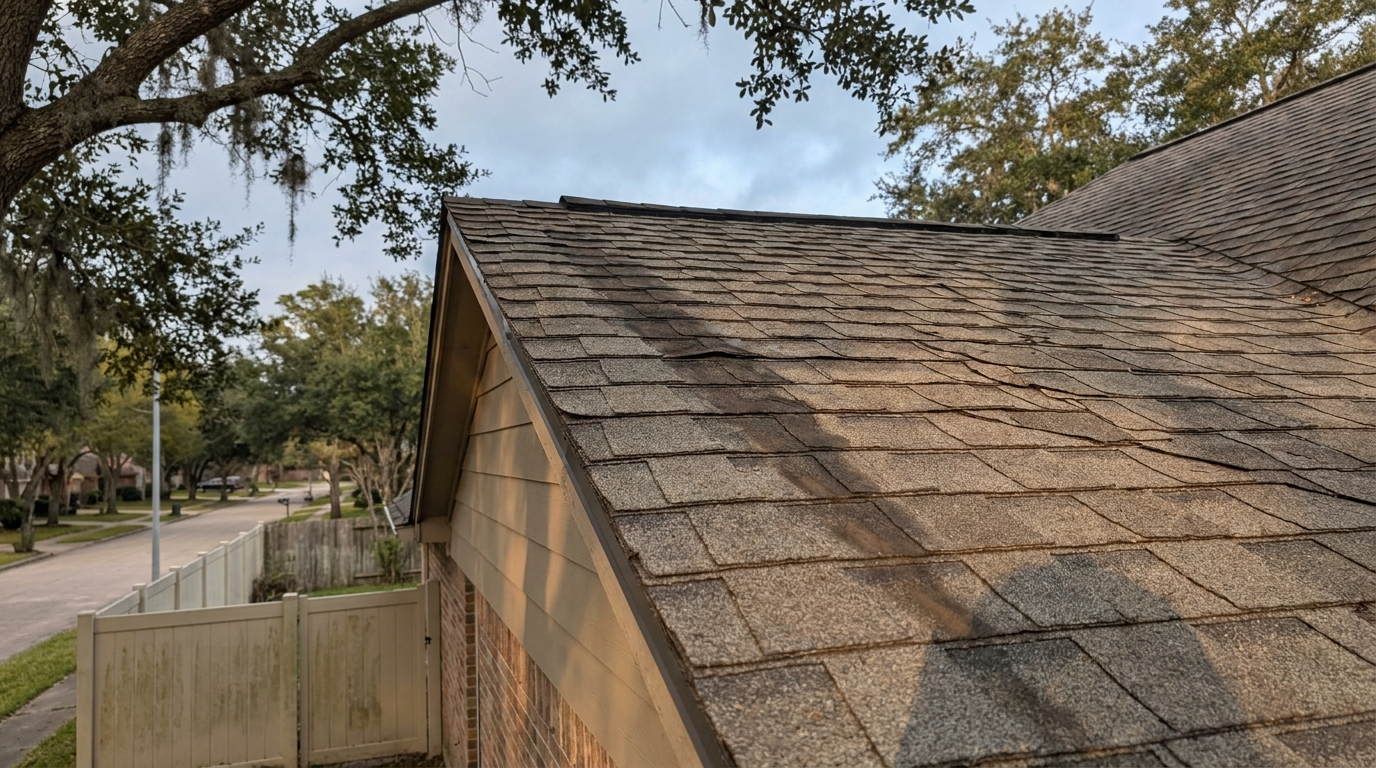
Why Does Roof Age Matter to Texas Home Insurance Carriers?
Carriers restrict coverage on older roofs because hail and wind damage claims rise sharply after a roof passes certain age milestones, and replacement cost payouts on aged roofs create loss ratios carriers cannot sustain.
Understanding roof age and Texas home insurance what changes at 10 15 and 20 years starts with understanding why carriers care about a number on a building permit in the first place. There is no single statewide law that automatically makes a roof uninsurable at 10, 15, or 20 years. Those age bands are carrier underwriting rules, not Texas statutes. [Source: Mortardesk] But the practical effect is the same: the older your roof, the harder it is to find full coverage at a reasonable premium.
The Claims Data Behind the Age Thresholds
Roof age matters because insurers use it as a proxy for future hail, wind, and water-intrusion risk. [Source: Texas Department of Insurance] A composition shingle roof that has weathered 15 Texas summers has absorbed ultraviolet degradation, thermal cycling, and possibly one or more hailstorms. Even if it looks fine from the ground, granule loss and micro-fractures reduce its ability to resist the next storm. Carriers track claim frequency and severity by roof age, and the data consistently shows older roofs generate larger payouts relative to the premium collected.
How Texas Hail and Wind Exposure Accelerates Roof Aging
Harris County and Montgomery County sit in one of the most active hail corridors in the country. Spring, Klein, Cypress, and The Woodlands all see regular spring hail events that shorten a roof’s effective lifespan compared to roofs in less exposed regions. That geographic reality is why Texas carriers apply age thresholds more aggressively than carriers in states with less severe weather. If you live in these north Houston suburbs, your roof’s calendar age and its effective condition may diverge faster than you expect.
What Happens at 10 Years: The First Underwriting Checkpoint
At 10 years, most Texas carriers require a roof inspection before binding or renewing coverage, and some begin applying actual cash value settlement to wind and hail claims instead of replacement cost.
The 10-year mark is where the underwriting conversation changes. Your roof is still usually in the mainstream market, but some carriers begin to ask more questions, require inspections, or narrow pricing options. [Source: Mortardesk]
Inspection Requirements: What the Inspector Checks
The Texas Department of Insurance confirms that insurers can inspect a roof when you apply or renew, and they may change coverage terms based on what they find. [Source: TDI] A typical carrier inspection at the 10-year mark looks at granule loss on shingles, flashing condition around vents and chimneys, evidence of prior patching or repairs, and overall structural integrity. The inspector may photograph the roof from the ground, from a ladder, or using a drone.
If you are in Spring or Klein and your roof has survived multiple hail seasons, expect the inspector to pay close attention to soft spots and impact marks, even if you have never filed a claim.
ACV vs. RCV Wind/Hail Settlement After 10 Years
This is where the financial impact starts. One Texas insurance source reports roof-age coverage changes as: 0 to 5 years at 100% replacement cost, 6 to 10 years at 80%, 11 to 15 years at 60%, 16 to 20 years at 40%, and 21-plus years at 20%. [Source: Mortardesk]
Here is a hypothetical example to show the difference. Suppose a hailstorm damages your roof and the replacement cost is $15,000. Your policy has a $2,500 deductible.
-
Under RCV (replacement cost): The carrier pays $15,000 minus $2,500 deductible = $12,500.
-
Under ACV at 10 years (hypothetical 20% depreciation): The carrier calculates the depreciated value at $12,000, then subtracts the $2,500 deductible = $9,500.
That $3,000 gap comes out of your pocket. For a deeper explanation of how these settlement methods work, see our guide on actual cash value vs replacement cost settlement.
Which Carriers Still Offer Full RCV at 10 Years?
Carrier-specific thresholds vary, and we cannot name individual carriers’ rules here without a cited underwriting guide for each one. At 10 years, many standard Texas carriers still offer replacement cost settlement if the roof passes inspection. The key is comparing quotes before your renewal date, because the carrier you are with today may treat a 10-year-old roof differently than a competitor does.
What Changes at 15 Years: Tighter Restrictions and Higher Premiums
At 15 years, many carriers will not quote new business without a recent inspection showing excellent condition, and most apply actual cash value to wind and hail claims regardless of inspection results.
Multiple Texas insurance guides published in 2026 describe 15 years as the point where underwriting gets materially tighter, with some insurers shifting from replacement cost to actual cash value or adding conditions before renewal. [Source: Mortardesk]
New Business vs. Renewal: Different Rules at 15 Years
There is an important distinction here. If you are renewing with your current carrier, they may continue coverage with an ACV endorsement on the roof. If you are shopping for a new policy, many carriers will decline to write new business on a 15-year-old roof without strong documentation of condition. Most Texas insurers now refuse to write new policies for roofs over 15 to 20 years old, and after 20 years options are often limited to specialty carriers. [Source: Mortardesk]
The Inspection Window: How Recent Must It Be?
Industry practitioners typically require an inspection completed within 90 days of the policy effective date, though some carriers accept inspections up to six months old. If your roof is approaching 15 years and you plan to shop for coverage, scheduling an inspection before you start quoting can save time. An inspection that is too old may need to be repeated at your expense.
Premium Increases Tied to Roof Age
Homes with roofs 11 to 15 years old pay an average of $155 more per year than homes with roofs under 5 years old, and beyond 15 years some carriers add $300 to $800 annually or convert the roof to ACV. [Source: Mortardesk] Texas premiums may also rise 5% to 15% when carriers start shifting to ACV or requiring inspections. [Source: Mortardesk]
If your renewal premium jumped and you are not sure whether the increase is age-related or market-wide, check your declarations page for any new endorsements. Our guide on what to check before you renew walks you through that process.
What Happens at 20 Years: The Coverage Cliff
At 20 years, most standard Texas carriers will not write new policies and many will not renew existing policies unless the roof is replaced, leaving homeowners with the FAIR Plan or non-admitted carriers as the only options.
A TDI example illustrates the financial reality: for a roof with a $4,000 deductible, a 5-year-old roof might receive $4,500 after a claim, a 10-year-old roof $3,000, and a 20-year-old roof $0 after depreciation and deductible are applied. [Source: Mortardesk] That is the coverage cliff in practice. Once a policy moves from replacement cost to ACV, the homeowner can absorb most or all of the loss.
| Roof Age | Typical Texas Insurance Change | What It Means for You |
|---|---|---|
| 0 to 5 years | Replacement cost coverage, fewer restrictions | Easiest to insure, best settlement terms |
| 6 to 10 years | Some carriers scrutinize condition, possible inspection | Premiums may start rising, but standard coverage usually available |
| 11 to 15 years | More carriers shift to ACV, add roof payment schedules | Average $155/year more than under-5 roofs; claim payouts reduced by depreciation |
| 16 to 20 years | Many insurers tighten terms, ACV common | Some carriers add $300 to $800/year or decline new business |
| 21+ years | Nonrenewal risk rises sharply, specialty markets likely | Standard carriers may decline; FAIR Plan or non-admitted carriers may be only options |
Carriers That Will Not Renew After 20 Years
We cannot list specific carrier names without cited underwriting guides for each, but the pattern is consistent across the Texas market. At 20 years, some insurers stop writing or renewing policies, especially if the roof condition is uncertain. [Source: Mortardesk] If you receive a nonrenewal notice, you typically have 60 days to find alternative coverage.
Texas FAIR Plan as the Backstop for Older Roofs
The Texas FAIR Plan (Fair Access to Insurance Requirements) exists for homeowners who cannot find coverage in the standard market. It provides basic property coverage, but premiums are typically higher and coverage limits may be lower than what you had with a standard carrier. The FAIR Plan is a last resort, not a long-term solution.
Non-Admitted Carriers: Higher Premiums, Fewer Protections
Non-admitted (surplus lines) carriers are not backed by the Texas Guaranty Association, which means if the carrier becomes insolvent, you have no state safety net for unpaid claims. Premiums from non-admitted carriers are generally higher, and policy terms may be more restrictive. If your roof pushes you into this market, understanding the tradeoffs is important before you bind.
How to Document a Roof Replacement So Carriers Accept the New Age
Carriers require a dated receipt, building permit, or contractor invoice showing the replacement date. Without documentation, they treat the roof as the original age listed in county appraisal records.
This is one of the most common problems we see. A homeowner replaced the roof eight years ago but has no receipt or permit. The new carrier pulls the Harris County Appraisal District (HCAD) or Montgomery Central Appraisal District (MCAD) records, sees the original build year, and treats the roof as 22 years old. That single missing document can be the difference between replacement cost coverage and an ACV endorsement, or between a standard policy and a FAIR Plan placement.
What Counts as Acceptable Proof of Replacement
The strongest documentation is a complete roof file: date-stamped before-and-after photos, an itemized final invoice showing materials, labor, and completion date, a building permit and final inspection sign-off, warranty registration or transfer documents, and product labels or manufacturer information. [Source: Jamarroofing]
Texas regulators also say that when you replace the roof, you should tell your insurance company so they can update the age. [Source: TDI]
How to Retrieve a Building Permit After the Fact
If you live in unincorporated Harris County, contact the Harris County Permit Office to request a copy of the building permit by address. In Montgomery County, the permit office can search by property address as well. If the work was done inside a city’s jurisdiction (such as the City of Houston or the City of Spring), contact that city’s permitting department. Permit records are public, and most offices can provide copies for a small fee.
What to Do If You Have No Documentation
If you have no receipt, no permit, and no photos, you still have options. Ask the roofing contractor if they kept records. Check your email and bank statements for payments around the replacement date. Contact the shingle manufacturer with the product name (visible on any remaining packaging or attic labels) to see if a warranty was registered. Some carriers will accept a professional roof inspection report that estimates the roof’s effective age based on material condition, though this is carrier-specific.
Does a Roof Inspection Ensure Coverage or Lower Premiums?
A passing inspection may keep you eligible for coverage, but it does not ensure replacement cost settlement or prevent premium increases. Each carrier sets its own age-based underwriting rules regardless of condition.
This is a critical point that many homeowners misunderstand. You pay $150 to $400 for an inspection, the roof passes, and you assume you are back to full replacement cost coverage. That is not how it works. The expert consensus in the research is consistent: roof age matters, but condition and insurer-specific underwriting matter more than the birthday alone. [Source: Mortardesk] A carrier may still apply an ACV endorsement to a 16-year-old roof that passes inspection simply because their underwriting guidelines say ACV applies after 15 years.
An inspection is necessary to stay in the game. It is not sufficient to win it. Think of it as a prerequisite, not a promise.
Can You Switch Carriers to Avoid Roof Age Restrictions?
Switching carriers does not reset roof age restrictions. All carriers check the roof age in county appraisal records or require documentation, and age-based rules apply whether you are a new customer or renewing.
That said, switching can still help. Carriers differ in where they draw their age thresholds and how they apply them. One carrier may shift to ACV at 13 years while another holds replacement cost to 15 or even 17 years with a passing inspection. The practical pattern is that around 10 years some carriers start tightening pricing or inspections, 15 years is where more carriers shift from replacement cost to ACV, and 20 years is where nonrenewal or ACV-only treatment becomes much more common. [Source: Mortardesk]
Shopping multiple carriers through an independent agency lets you see which ones will still offer replacement cost coverage at your roof’s current age. That comparison is most valuable when your roof is between 10 and 15 years old, because that is the window where carrier-to-carrier differences are widest. Also review your percentage wind and hail deductibles, because a lower deductible on an ACV policy may still leave you worse off than a higher deductible on an RCV policy.
What Should You Do If Your Roof Is Approaching a Threshold?
Schedule an inspection before the renewal date to identify issues early, gather replacement documentation if you replaced the roof, and compare quotes from multiple carriers because age thresholds and settlement terms vary widely.
Here is a practical checklist:
-
Check your roof’s age in county records. Pull your property record from HCAD (hcad.org) or MCAD (mcad-tx.org). That is the age your carrier will use unless you provide proof of replacement.
-
Gather documentation. If you replaced the roof, assemble your invoice, permit, photos, and warranty. If you bought the house after a replacement, ask the seller or their agent for records.
-
Schedule an inspection before renewal. Do not wait for the carrier to require one. A proactive inspection gives you time to make minor repairs that could affect the outcome.
-
Read your declarations page. Look for any roof-specific endorsements, ACV language, or roof payment schedules. Our guide on how to read your declarations page explains what to look for.
-
Compare quotes 60 to 90 days before renewal. This gives you time to gather any additional documentation a new carrier requests.
-
Notify your carrier of any replacement. If you replaced the roof and did not tell your insurer, do it now. They need the updated age to adjust your coverage and premium.
A proposed Texas rule discussed in 2026 would make it harder for insurers to refuse coverage based solely on the age of a component like a roof, but that rule was still proposed, not adopted, as of mid-September 2026. [Source: Mortardesk] Until the regulatory landscape changes, the underwriting thresholds described above remain the practical reality for Texas homeowners.
If your roof is approaching 10, 15, or 20 years and you are not sure what your current policy says about wind and hail settlement or what an inspection will cost, send us your declarations page or request a quote for Texas homeowners insurance and we will walk you through your options in plain English, whether or not you switch.
Frequently Asked Questions
Is there a Texas law that makes a roof uninsurable at a certain age?
No. There is no statewide law that automatically makes a roof uninsurable at 10, 15, or 20 years. Those age bands are carrier underwriting rules, not Texas statutes. [Source: Mortardesk] Each carrier sets its own thresholds for inspections, ACV endorsements, and nonrenewal.
What is the difference between ACV and RCV for a roof claim?
Replacement cost value (RCV) pays the full cost to replace your roof with similar materials. Actual cash value (ACV) subtracts depreciation based on the roof’s age and condition. A TDI example shows a 20-year-old roof under ACV can receive $0 after depreciation and the deductible are applied. [Source: Mortardesk] See our guide on actual cash value vs replacement cost settlement for a full explanation.
How much more does insurance cost with an older roof?
Homes with roofs 11 to 15 years old pay an average of $155 more per year than homes with roofs under 5 years old. Beyond 15 years, some carriers add $300 to $800 annually or convert the roof to ACV. [Source: Mortardesk] Exact amounts vary by carrier, location, and roof condition.
How do I find out what age my carrier has on file for my roof?
Check your declarations page for the roof year listed. You can also pull your property record from the Harris County Appraisal District (hcad.org) or Montgomery Central Appraisal District (mcad-tx.org) to see the year the improvement was recorded. If those records show the original build year and you replaced the roof, you need to provide documentation to your carrier.
Will a roof inspection lower my premium?
Not necessarily. A passing inspection may keep you eligible for coverage, but carriers apply age-based underwriting rules regardless of condition. A 16-year-old roof that passes inspection may still receive an ACV endorsement if the carrier’s guidelines require it after 15 years.
What happens if my carrier nonrenews me because of roof age?
You typically have 60 days to find alternative coverage. Options include other standard carriers (if your roof passes their inspection), non-admitted surplus lines carriers, or the Texas FAIR Plan as a last resort. An independent agent can help you compare these options before the nonrenewal takes effect.
I replaced my roof but lost the receipt. What can I do?
Contact the roofing contractor for a copy of the invoice. Check your bank or credit card statements for the payment. Request a copy of the building permit from your local permit office. If a warranty was registered with the shingle manufacturer, they may have the installation date on file. Some carriers will also accept a professional inspection report estimating the roof’s effective age.
Should I replace my roof before it hits 15 or 20 years just for insurance purposes?
That depends on the math. Compare the cost of a new roof against the premium savings, the improved claim settlement (RCV vs. ACV), and the risk of a storm hitting before you replace. A hypothetical example: if replacing your roof costs $12,000 and saves you $400 per year in premium while restoring full replacement cost coverage on a $15,000 potential claim, the financial case is stronger than if the savings are $150 per year. Every situation is different, and this is not financial advice.
Related guides
Want a quote that accounts for this?
Start a quote or email us your declarations page, and we'll compare carriers for you.
Get a quoteOr read about home insurance in Texas first.
Sources
This guide is general information about Texas insurance as of the date above, not advice about your specific policy. Laws, rates, and carrier rules change, and your policy documents control if anything here differs. Spot an error? Email hello@alongsideinsurance.com and we'll fix it. How we write these guides.