
Why Houston Home Insurance Costs More Than the Rest of Texas
Houston homeowners pay 15-30% more than state averages. Flood zones, hail frequency, coastal proximity, and claims density drive the gap. Here's why.
12 minute read. Published September 28, 2026. By Alongside Insurance.
The short version
- Houston's combination of coastal hurricane exposure, severe hail risk, flood-prone geography, and high claims density makes it the most expensive major metro in Texas for homeowners insurance.
- Houston homeowners pay roughly $800 to $1,800 more per year than the Texas average, depending on coverage level and data source, with the gap widening for homes in flood-prone ZIP codes.
- Flood zones do not directly increase your homeowners premium, but carriers price higher base rates across Houston ZIP codes because the metro's overall flood exposure raises total loss expectations.
- Houston lies within the Texas coastal wind corridor, which triggers higher base rates and percentage wind/hail deductibles because hurricane exposure extends well inland from Galveston Bay.
- Texas remains the nation's most hail-active state, and carriers price Houston's rising roof replacement costs into every renewal because each hail claim has grown more expensive even as claim frequency has dipped.
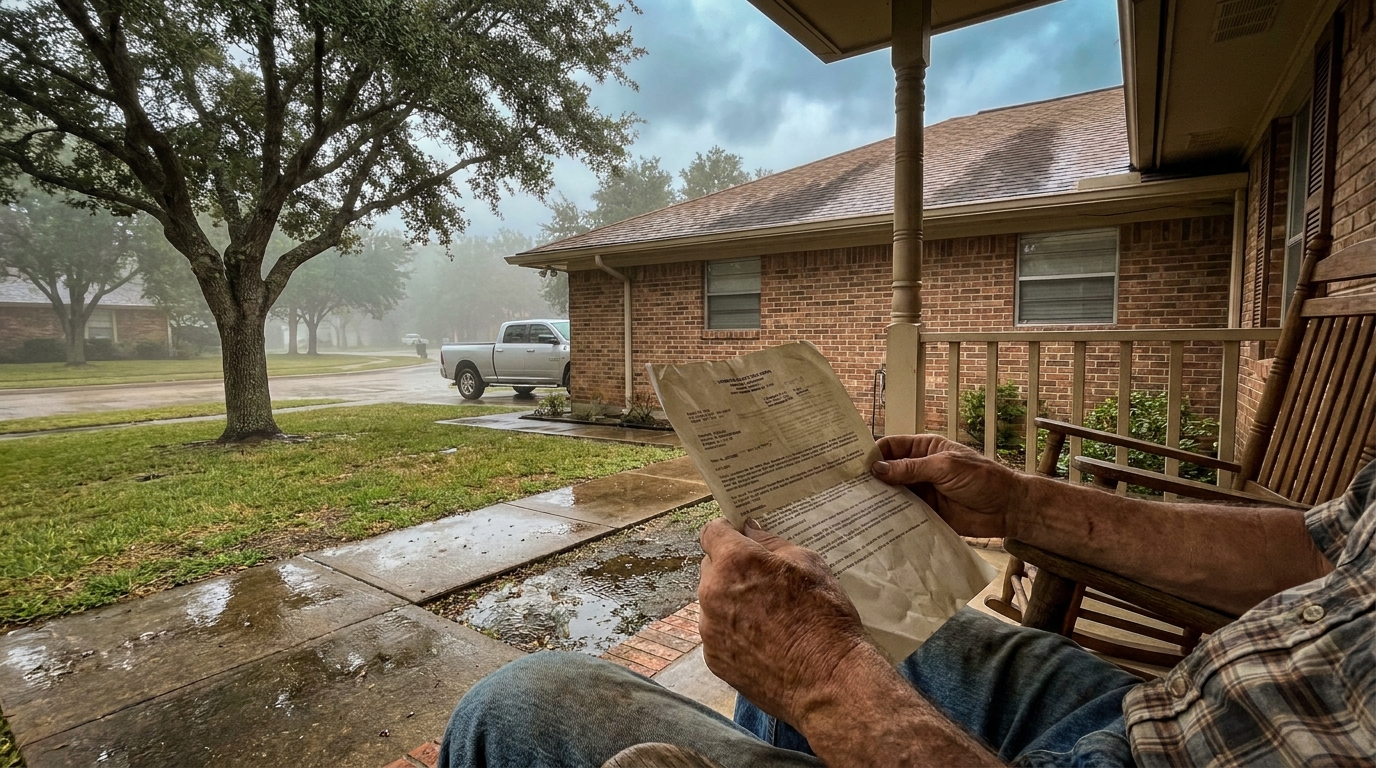
Why Does Houston Home Insurance Cost More Than Dallas, Austin, or San Antonio?
Houston’s combination of coastal hurricane exposure, severe hail risk, flood-prone geography, and high claims density makes it the most expensive major metro in Texas for homeowners insurance.
Understanding why Houston home insurance costs more than the rest of Texas starts with one fact: Houston sits where multiple weather hazards overlap in ways that Dallas, Austin, and San Antonio simply do not experience. The city lies near the Gulf Coast, with bayous threading through every neighborhood. Spring hailstorms hammer roofs year after year. And when a hurricane makes landfall, the entire metro feels it.
Insurance.com attributes Houston’s higher rates “largely due to its proximity to the coast and vulnerability to hurricanes.” [Source: Insurance.com] That coastal exposure is layered on top of a state that is already expensive to insure. The Consumer Federation of America data cited by Kin shows Texas averaged $4,786 per year in 2024, versus a national average of $3,303. [Source: Kin] Houston sits well above even that elevated Texas baseline.
For a deeper look at statewide factors, see our guide on why Texas home insurance costs so much.
How Much More Do Houston Homeowners Pay Compared to the Texas Average?
Houston homeowners pay roughly $800 to $1,800 more per year than the Texas average, depending on coverage level and data source, with the gap widening for homes in flood-prone ZIP codes.
Multiple industry sources confirm the premium gap, though exact dollar amounts vary by coverage assumptions. Here is how Houston stacks up against other major Texas metros:
| City | NerdWallet Estimate | Insurance.com Estimate | Insurify Estimate |
|---|---|---|---|
| Houston | $9,095/yr | $5,539/yr | $6,072/yr |
| Dallas | $6,915/yr | $4,362/yr | $5,136/yr |
| San Antonio | $4,565/yr | $2,945/yr | $3,564/yr |
| Austin | $4,250/yr | $2,822/yr | $3,168/yr |
[Sources: NerdWallet, Insurance.com, Insurify via Yahoo Finance]
The wide range across sources reflects different coverage assumptions, but the ranking is consistent: Houston is always the most expensive major metro. Hippo notes that Houston homeowners generally pay about 1% to 41% more than the Texas average, depending on coverage level. [Source: Hippo]
Worked example (hypothetical): Suppose you own a $300,000 home in Spring, Texas, in Harris County. Using a mid-range estimate of about $5,500 per year for Houston-area homeowners coverage, compare that to a similar $300,000 home in Plano (Collin County, Dallas metro) at roughly $4,400. That is about $1,100 per year more, or roughly $92 extra per month, for the same dwelling value and similar coverage limits.
The Dallas Fed reported that the median Texas homeowner paid 60% more for home insurance in 2024 than in 2019. [Source: Dallas Fed] Houston sits above that already-elevated statewide trend.
Does Living in a Flood Zone Raise Your Houston Home Insurance Premium?
Flood zones do not directly increase your homeowners premium, but carriers price higher base rates across Houston ZIP codes because the metro’s overall flood exposure raises total loss expectations.
This distinction confuses a lot of homeowners. Your standard homeowners policy does not cover flooding. But insurers know that flood-prone areas generate more claims overall, including wind, water intrusion, and mold, so they factor that regional risk into your base rate even before you buy a separate flood policy.
Policygenius found that one Houston ZIP code, 77089 (South Belt/Ellington), averages $3,360 per year for homeowners insurance alone, illustrating how flood-prone neighborhoods inside the metro can cost significantly more than the city average. [Source: NerdWallet]
How FEMA Flood Maps Affect Carrier Underwriting in Harris County
FEMA flood maps designate zones (A, AE, X, and others) that carriers use as one input in their underwriting models. But the maps are not the only input. Carriers also look at elevation, proximity to bayous, historical claims in your area, and drainage capacity.
Under FEMA’s Risk Rating 2.0, annual flood premiums can rise by up to 18% per year until they reach full risk-based pricing, and Harris County has been projected to see significant long-term increases in average flood premiums. [Source: Hippo] That means your flood insurance cost may keep climbing even if your homeowners premium stays flat.
Why You Need Separate Flood Coverage Even If You’re Not in a High-Risk Zone
Zone X is not “safe.” It means mapped risk is lower or uncertain, not absent. [Source: Latent Insure] In Houston, heavy rain events can overwhelm drainage systems in any neighborhood, regardless of FEMA designation. KHOU quoted the Kinder Institute’s Greg Chung as saying premiums are tied to “the cost of the land underneath those homes and their location within floodways and flood zones.” [Source: Rice Kinder Institute]
If you carry only a homeowners policy and your home floods, you have no coverage for the water damage. A separate flood policy, whether through the NFIP or a private carrier, is the only way to close that gap.
How Do Hurricanes and Coastal Proximity Drive Houston Premiums?
Houston lies within the Texas coastal wind corridor, which triggers higher base rates and percentage wind/hail deductibles because hurricane exposure extends well inland from Galveston Bay.
One report described Houston as “very high risk” for eight natural hazards, including hurricanes and tornadoes, with Houston receiving the nation’s highest risk score for those two hazards. [Source: Latent Insure] That risk score translates directly into how carriers price your policy.
The Coastal Wind Tier: How Distance from the Gulf Affects Your Rate
Texas carriers typically apply tiered wind pricing based on distance from the coast. Homes closer to Galveston Bay may carry percentage wind/hail deductibles of 1% to 5% of dwelling coverage instead of a flat dollar amount. On a $300,000 home, a 2% wind/hail deductible means you would pay the first $6,000 of any wind or hail claim out of pocket. [Source: MoneyGeek]
Standard homeowners policies generally cover wind damage from hurricanes, but that percentage deductible structure means your out-of-pocket exposure is much higher than in Austin, where a flat $2,500 deductible is more common.
Hurricane Beryl (2024) and the Derecho: How Recent Storms Raised Premiums Across the Metro
The Texas Tribune reported that Texas homeowners premiums jumped 23% in 2023, the highest increase in the country, citing researchers who pointed to population growth, rising rebuilding costs, and more intense storms. [Source: Texas Tribune] Yahoo Finance, citing Insurify, reported Houston as the most expensive major metro in Texas, with an average premium of $5,653. [Source: Yahoo Finance]
For a closer look at how recent storms affected Houston-area renewals, see our guide on how Hurricane Beryl and the May derecho raised premiums.
Why Does Hail Frequency in Houston Cost You More?
Texas remains the nation’s most hail-active state, and carriers price Houston’s rising roof replacement costs into every renewal because each hail claim has grown more expensive even as claim frequency has dipped.
The Texas Department of Insurance reports that over the last four years, the cost of hail claims has been 10% above the 16-year average, even though claim frequency was below that average. [Source: Latent Insure] That means each hail claim is getting more expensive, driven by higher material and labor costs for roof replacements.
A 2023 Texas legislative handout noted that hail events that year damaged two million homes statewide. In the Dallas-Fort Worth area alone, 2023 storms caused $7 billion to $10 billion in insured losses, with 95% caused by hail. Houston does not see quite that concentration, but it still averages significant hail activity each spring, and carriers spread those regional losses across the metro’s rate base. [Source: Latent Insure]
NerdWallet survey data cited by the Texas Tribune found Houston homeowners paid about $4,400 per year on average for wind, rain, and hail coverage. A full Houston stack of homeowners plus flood plus wind coverage can total $6,000 to $10,000 per year depending on location and rebuild cost. [Source: Insurance.com]
Does Houston’s Claims Density Make Premiums Higher?
Yes. Harris County generates more homeowners claims and larger total paid losses than most other Texas counties, and carriers raise rates when loss ratios exceed their underwriting targets in a metro area.
In a Texas A&M Real Estate Research Center snapshot, Houston had 154,067 reported homeowners claims, with 61.8% closed with payment, generating about $2.49 billion in paid losses and $2.95 billion in case-incurred losses. [Source: Texas A&M TRERC] The bulk of loss dollars in that analysis were concentrated in Dallas-Fort Worth and Houston, with Houston alone accounting for far more paid losses than Austin or San Antonio.
A study published in the ASCE Journal found that a 20% increase in policy density in Houston was associated with an average 60% increase in the number of flood insurance claims and a 20% increase in total claim amounts. When policy density and flooding both rose by 20%, claims increased by 120% and total claim amounts by 38%. [Source: ASCE Library]
Harris County homeowners paid about $3,325 in property insurance premiums in 2023, up from $2,325 in 2015, a 43% increase. [Source: Rice Kinder Institute] That rise tracks directly with higher claim counts and more expensive repairs across the county. One industry report also noted that in 2023, nearly 47% of homeowner insurance claims in Texas were closed without payment, suggesting a large volume of disputed or non-indemnified claims that can raise administrative costs for insurers. [Source: InsuranceNewsNet]
How Do Bayous, Watersheds, and Drainage Infrastructure Affect Your Rate?
Homes near major bayous and creeks face higher premiums because carriers model flood risk using Harris County Flood Control District data and historical loss patterns that reflect Houston’s flat, drainage-challenged terrain.
Houston is built on a low-lying, flat coastal plain with a dense network of bayous and watersheds. Heavy rain accumulates quickly and spreads across large areas before draining to the coast. That geography means a home several miles from the nearest bayou can still flood during an intense rain event if drainage infrastructure is overwhelmed.
Texas A&M’s Real Estate Research Center found that Houston’s recent insurance cost deterioration is mainly due to increased claim counts. [Source: Texas A&M TRERC] By 2024, Houston’s average monthly property insurance cost was $225, versus $181 in Austin and $157 in San Antonio. [Source: Hippo]
Rice’s Kinder Institute reports the Houston-region average near $6,610 annually, among the highest in the country, and notes premiums in the Houston area have climbed more than 40% over the past decade. [Source: Rice Kinder Institute] The Dallas Fed attributes the broader Texas premium surge to a combination of construction costs and destructive weather. [Source: Dallas Fed]
If you want to understand exactly what your current policy covers and what it does not, our guide on how to read your declarations page walks through every line item.
Will Moving to Katy, Cypress, Spring, or The Woodlands Lower Your Premium?
Premiums may drop modestly in northern suburbs due to lower claims density, but flood and wind exposure remain similar across the metro, limiting the savings.
Suburban ZIP codes in Spring, The Woodlands, or Cypress can have slightly lower base rates because they are farther from the coast and may have newer housing stock with updated roofs. But these areas still sit within the same broad wind tier as Houston proper, and many neighborhoods along Cypress Creek and Spring Creek carry their own flood risk.
Worked example (hypothetical): A $300,000 home in Spring (ZIP 77379) might see an annual homeowners premium around $5,000, compared to $5,500 for a similar home in the Meyerland area near Brays Bayou. That is roughly a $500 annual difference. But if the Spring home sits in a Cypress Creek flood zone and needs a separate flood policy at $1,200 per year, the total insurance cost may actually be higher.
The takeaway: moving to the suburbs can help, but it will not eliminate the fundamental cost drivers that make the entire Houston metro more expensive than Dallas, Austin, or San Antonio.
What Can You Do to Lower Your Houston Home Insurance Cost?
Shop multiple carriers annually, raise your wind/hail deductible, invest in wind mitigation upgrades, and bundle home and auto policies to target the specific factors that drive Houston premiums higher.
Insurify notes that Houston premiums are being pushed by severe storms, inflation, rising property values, and increased construction costs. [Source: Insurify via Yahoo Finance] You cannot change the weather, but you can control how your home is rated and which carrier prices your specific risk profile most competitively.
Fortified Roof and Wind Mitigation Discounts
Upgrading to impact-resistant shingles, reinforcing roof decking, or installing wind-rated garage doors can qualify you for wind mitigation credits with many carriers. These upgrades reduce the insurer’s expected payout after a storm, and they pass some of that savings back to you. The exact credit varies by carrier and policy, so ask your agent which mitigation features your insurer rewards.
How Bundling Home and Auto Cuts Your Premium
Most carriers offer a multi-policy discount when you bundle homeowners coverage with an auto policy. The discount varies by carrier, but it is one of the simplest ways to reduce your total insurance spend without changing your coverage limits. An independent agency can quote both policies across multiple carriers to find the combination that works for your situation.
When to Consider a Higher Deductible
Raising your wind/hail deductible from 1% to 2% of dwelling coverage can lower your annual premium noticeably. On a $300,000 home, that means accepting $6,000 in out-of-pocket exposure instead of $3,000 on a wind or hail claim. If you have an emergency fund that can absorb that difference, the premium savings over several claim-free years can be worth it.
Frequently Asked Questions
Why is Houston home insurance more expensive than Dallas?
Houston’s proximity to the Gulf Coast adds hurricane and flood exposure that Dallas does not face. Insurance.com lists Houston at $5,539 per year versus $4,362 for Dallas on comparable coverage. [Source: Insurance.com] Dallas has severe hail risk, but Houston layers coastal wind, flood, and hail together.
Does my FEMA flood zone affect my homeowners insurance premium?
Not directly. Standard homeowners policies do not cover flooding, so your flood zone designation affects your separate flood insurance cost. However, carriers do price higher base rates across flood-prone Houston ZIP codes because overall loss exposure is elevated in those areas.
How much has Houston home insurance gone up in recent years?
Harris County homeowners paid about $3,325 in premiums in 2023, up 43% from $2,325 in 2015. [Source: Rice Kinder Institute] The Dallas Fed reported that the median Texas homeowner paid 60% more in 2024 than in 2019. [Source: Dallas Fed]
Will my premium drop if I move from Houston to The Woodlands or Katy?
It may decrease modestly depending on your specific ZIP code, roof age, and flood zone. But the entire Houston metro shares similar wind and hail exposure, so the savings are limited compared to moving to Austin or San Antonio.
What is a percentage wind/hail deductible?
Instead of a flat dollar amount, your deductible is a percentage of your dwelling coverage. A 2% deductible on a $300,000 home means you pay the first $6,000 of any wind or hail claim. These are common in the Houston metro due to coastal wind exposure. Learn more in our guide on percentage wind/hail deductibles.
Do I need flood insurance if I’m in Zone X?
Zone X means your mapped risk is lower, not that you are safe from flooding. [Source: Latent Insure] In Houston, heavy rain can overwhelm drainage in any neighborhood. A separate flood policy is the only way to cover water damage to your home.
Can an independent agent help me find a lower premium in Houston?
An independent agency shops your specific risk profile, including your ZIP code, roof age, claims history, and flood zone, across multiple carriers. Different carriers price the same Houston address differently, so comparing quotes is one of the most effective ways to manage your premium.
Is Houston the most expensive city in Texas for home insurance?
Among major metros, yes. Yahoo Finance, citing Insurify, reported Houston as the most expensive major metro in Texas, with an average premium of $5,653. [Source: Yahoo Finance] Only smaller coastal cities like Port Lavaca and Bay City were higher.
Related guides
Want a quote that accounts for this?
Start a quote or email us your declarations page, and we'll compare carriers for you.
Get a quoteOr read about home insurance in Texas first.
Sources
- Insurance.com
- Kin
- Hippo
- Dallas Fed
- NerdWallet
- Latent Insure
- Rice Kinder Institute
- MoneyGeek
- Texas Tribune
- Yahoo Finance
- Texas A&M TRERC
- ASCE Library
This guide is general information about Texas insurance as of the date above, not advice about your specific policy. Laws, rates, and carrier rules change, and your policy documents control if anything here differs. Spot an error? Email hello@alongsideinsurance.com and we'll fix it. How we write these guides.