
How Hurricane Beryl and the May Derecho Raised Houston Home Insurance Premiums
Hurricane Beryl and the May 2024 derecho triggered $5+ billion in Texas claims. Here's how those storms changed Houston home insurance premiums in 2025-2026.
13 minute read. Published September 18, 2026. By Alongside Insurance.
The short version
- Two catastrophic wind events struck the Houston metro within 53 days of each other, generating billions in insured losses and setting the stage for the premium increases Harris County homeowners are seeing today.
- Insurers raised premiums because the derecho and Beryl together triggered billions in Texas claims, forcing carriers to file rate increases with TDI to cover losses and rising reinsurance costs.
- Both factors may be at work: if you filed a claim, your individual rate likely increased at renewal, but even homeowners who filed nothing saw area-wide rate increases applied to all Harris and Montgomery County policies.
- Houston-area homeowners reported renewal increases ranging from roughly 15% to over 40% in late 2024 and early 2025, with the steepest jumps in north Houston suburbs hit hardest by both storms.
- Switching may help if your current carrier raised rates more aggressively than competitors, but most insurers serving Houston filed similar increases after Beryl and the derecho, so expect comparable quotes across the market.
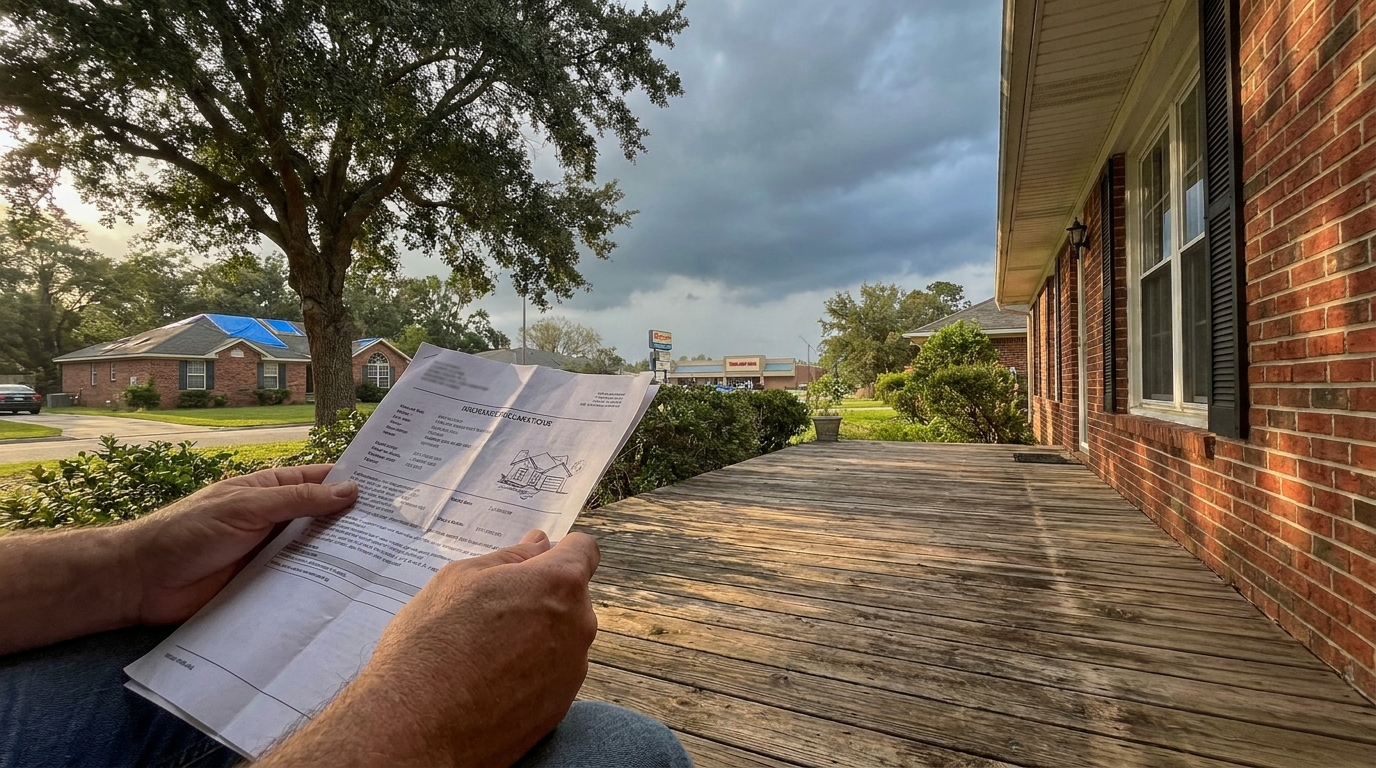
What Happened During the May 2024 Derecho and Hurricane Beryl in Houston?
Two catastrophic wind events struck the Houston metro within 53 days of each other, generating billions in insured losses and setting the stage for the premium increases Harris County homeowners are seeing today.
If you’re a homeowner in Spring, Klein, Cypress, or The Woodlands trying to understand why your hurricane Beryl and May 2024 derecho Houston insurance premiums climbed so sharply, the answer starts with what actually hit the ground in those two storms and how much it cost insurers to pay the claims.
May 16, 2024 derecho: wind damage across Spring, Klein, Cypress, and The Woodlands
On May 16, 2024, a derecho, a fast-moving line of severe thunderstorms with sustained straight-line winds, tore through the Houston metro. Wind gusts reached 100+ mph in parts of central and eastern Texas, blowing out roughly 3,000 downtown Houston windows and toppling trees across the northern suburbs. [Source: Wikipedia] The National Weather Service confirmed the event spawned a couple of tornadoes alongside the straight-line wind damage. [Source: Harbert Group]
NOAA estimated total damage from the Southern Derecho at $1.6 billion across Texas and neighboring states. [Source: Wikipedia] Seven people died, and roughly 900,000 CenterPoint Energy customers lost power, with about 555,000 still without electricity more than 24 hours later. [Source: Harbert Group]
Hurricane Beryl (July 8, 2024): roof damage, flooding, and massive power outages
Less than two months later, Hurricane Beryl made landfall near Matagorda Bay on July 8, 2024, tracking directly through the Houston metro as a Category 1 storm. Beryl left nearly 2 million homes and businesses without power. About 215,000 CenterPoint Energy customers were still without electricity a full week after landfall. At least 18 fatalities in the Houston area were attributed to the storm. [Source: Rice University Kinder Institute]
Combined insured losses: billions across Texas
Moody’s RMS estimated U.S. insured losses from Beryl alone at $2.5 billion to $4.5 billion. [Source: Insurance Journal] A separate analysis by KCC pegged Beryl’s privately insured damage at roughly $2.7 billion. [Source: Reuters] Add the derecho’s $1.6 billion, and Texas carriers absorbed well over $4 billion in insured losses from just these two events in a single policy year.
Why Did Houston Home Insurance Premiums Go Up After These Storms?
Insurers raised premiums because the derecho and Beryl together triggered billions in Texas claims, forcing carriers to file rate increases with TDI to cover losses and rising reinsurance costs.
How catastrophic loss activity triggers statewide and regional rate filings
When insurers pay out more in claims than they collected in premiums for a given territory, they file new rates with the Texas Department of Insurance. Two catastrophic events in one policy year created what industry analysts describe as a “pricing trigger” for carriers, because insurers often raise base rates for an entire area after repeated catastrophe losses rather than only for individual claimants. [Source: Harbert Group]
Reinsurance costs spiked after back-to-back events
Insurers buy reinsurance to protect themselves during catastrophe years. The Dallas Fed found that recent global disaster losses pushed reinsurance costs higher, and those costs get passed through to homeowner premiums. At the same time, construction costs and labor shortages amplified rebuilding-cost inflation, meaning each claim cost more to settle. [Source: Federal Reserve Bank of Dallas]
TDI-filed rate increases in late 2024 and early 2025
Statewide homeowners insurance rate changes tell the story clearly. TDI filing data, as summarized by multiple industry sources, shows average annual increases of 10.8% in 2022, 21.1% in 2023, 18.7% in 2024, and 4.3% in 2025. [Source: Harbert Group] On the windstorm side, TWIA voted to seek a 10% rate increase for 2025 policies after Beryl, even though a rate-adequacy analysis indicated residential coverage would need about a 38% increase to be actuarially sound. [Source: Texas Tribune]
Did My Premium Go Up Because I Filed a Claim, or Did Everyone’s Premium Increase?
Both factors may be at work: if you filed a claim, your individual rate likely increased at renewal, but even homeowners who filed nothing saw area-wide rate increases applied to all Harris and Montgomery County policies.
Individual claim surcharges vs. area-wide rate increases
Texas rules say insurers should not rerate, cancel, nonrenew, or change premium solely because a policyholder was a victim or evacuee of Hurricane Beryl. [Source: Texas Tribune] That means a Beryl claim alone shouldn’t be the only reason for your increase. However, it doesn’t prevent your insurer from using broader claim and catastrophe experience when setting rates for your territory.
How Texas insurers apply catastrophe-driven rate changes by ZIP code
Carriers can raise rates by ZIP code based on loss history in that area. [Source: Harbert Group] If your ZIP code had a high concentration of derecho or Beryl claims, your territorial rating factor went up regardless of your personal claims record. This is why two neighbors on the same street, one who filed a claim and one who didn’t, can both see double-digit increases on the same renewal cycle.
Why your neighbor who didn’t file a claim also saw an increase
One Texas homeowner cited by AARP saw premiums rise 22% in 2023, 39% in 2024, and then 78% in 2025, even without filing a claim. The insurer pointed to storms including Beryl and the 2024 derecho as reasons for the broad-based increases. [Source: Harbert Group] If your renewal letter says “catastrophic losses,” “storm response,” or “reinsurance costs,” that usually points to an area-wide repricing rather than a personal claims penalty.
How Much Did Premiums Increase in Houston After Beryl and the Derecho?
Houston-area homeowners reported renewal increases ranging from roughly 15% to over 40% in late 2024 and early 2025, with the steepest jumps in north Houston suburbs hit hardest by both storms.
Typical increase ranges by carrier and ZIP code
Houston-area homeowners are now routinely paying $3,500 to $4,500 per year for a standard policy, which represents a 50% to 75% cumulative increase compared with 2022 levels. [Source: Harbert Group] The Urban Institute reported that in Harris County specifically, homeowner’s insurance costs rose 60.8% from 2014 to 2024, climbing from $2,664 to $4,284 annually. [Source: Harbert Group / Urban Institute data]
The Dallas Fed found that the median Texas homeowner paid 60% more for home insurance in 2024 than in 2019. [Source: Federal Reserve Bank of Dallas]
| Year | Average Statewide Rate Change | Source |
|---|---|---|
| 2021 | 5.9% | TDI filing data via Harbert Group |
| 2022 | 10.8% | TDI filing data via Harbert Group |
| 2023 | 21.1% | TDI filing data via Harbert Group |
| 2024 | 18.7% | TDI filing data via Harbert Group |
| 2025 | 4.3% | TDI filing data via Harbert Group |
Higher increases in north Houston suburbs (Spring, Klein, Cypress, The Woodlands)
ZIP codes in the northern suburbs took direct hits from both the derecho and Beryl’s inland wind field. Because insurers can apply territorial rate adjustments by ZIP code, areas with concentrated claims from both events saw the largest jumps. The Texas Tribune noted that Houston-area coastal windstorm rates could rise by about $230 per year for some policyholders on top of base-rate increases. [Source: Texas Tribune]
Worked example: a Spring homeowner’s renewal before and after the storms
Suppose a Spring homeowner paid $2,800 in annual premium when they renewed in early 2024, before Beryl. At their next renewal in early 2025, the same policy came back at $3,640, a 30% increase. The homeowner didn’t file a claim for either storm. The increase came from two line items on the declarations page: a higher territorial base rate (reflecting area-wide catastrophe losses) and an increased replacement cost estimate (reflecting higher construction costs). These are hypothetical numbers, but they illustrate the math many north Houston homeowners experienced. Understanding how to read your declarations page helps you see exactly which line items moved.
Will Switching Carriers Lower My Premium After a Storm-Driven Increase?
Switching may help if your current carrier raised rates more aggressively than competitors, but most insurers serving Houston filed similar increases after Beryl and the derecho, so expect comparable quotes across the market.
Why shopping after a catastrophe year still matters
Not every carrier filed the same percentage increase with TDI. Some insurers had less exposure in your ZIP code, or their reinsurance treaties absorbed losses differently. Texas premiums jumped 23% in 2023 according to an S&P Global analysis cited by the Texas Tribune, the highest increase in the country that year. [Source: Texas Tribune] But that’s a statewide average. Individual carriers may have filed 12% or 35% depending on their book of business. Shopping at least three carriers gives you a realistic picture of the current market floor.
How to compare apples-to-apples when every carrier raised rates
When you compare quotes, match these items exactly:
-
Dwelling coverage (Coverage A): same replacement cost limit
-
Wind/hail deductible: a lower premium might hide a 2% or 5% percentage wind/hail deductible instead of a flat dollar amount
-
Roof settlement method: actual cash value (ACV) vs. replacement cost value (RCV), which makes a huge difference on an older roof
-
Loss settlement endorsements: some carriers added roof-age schedules or cosmetic-damage exclusions after the 2024 storms
A quote that looks $400 cheaper but carries a 2% wind/hail deductible on a $350,000 home means you’d pay $7,000 out of pocket before coverage kicks in on a wind claim. That’s not savings. That’s a transfer of risk back to you.
What to check on your declarations page before you switch
Pull your current declarations page and look at the territorial base rate, the wind/hail deductible, the roof settlement method, and the replacement cost estimate. If you’re not sure what you’re reading, our guide on why Texas home insurance costs so much walks through the main cost drivers. An independent agent can then compare your current coverage to what other carriers offer at the same coverage level.
Are These Premium Increases Permanent, or Will Rates Come Back Down?
Storm-driven rate increases are typically permanent baseline adjustments, not temporary surcharges. Premiums may stabilize if Texas avoids major storms, but they rarely return to pre-storm levels.
How catastrophe losses reset the rate baseline
Insurers don’t add a temporary “storm surcharge” and then remove it. They file new base rates with TDI that reflect updated loss projections. Once those rates are approved, they become the new floor. Analysts cited by the Texas Tribune said insurers were expected to continue raising already-high premiums and become more selective about what damage they cover after Beryl. [Source: Texas Tribune]
What would need to happen for rates to decrease
The 2025 statewide average increase slowed to 4.3%, down from 18.7% in 2024. [Source: Harbert Group] That’s a deceleration, not a decrease. For rates to actually drop, Texas would need multiple consecutive years of below-average catastrophe losses, a decline in reinsurance costs, and stabilizing construction costs. Moody’s noted that Beryl losses would be “low and readily absorbed” and were not expected to change pricing conditions in property/casualty and reinsurance markets by themselves. [Source: Texas Tribune / Moody’s] That suggests Beryl alone won’t trigger a broad-market reset downward later, either.
Why FEMA flood map updates may add another layer of cost
Separately from wind and hail pricing, updated FEMA flood maps could reclassify properties in Harris and Montgomery counties into higher-risk flood zones. If your home moves into a Special Flood Hazard Area, your mortgage lender will require flood insurance, adding another annual cost on top of your homeowners premium. This is a different policy and a different cost, but it compounds the overall insurance burden for Houston homeowners.
What Should You Do If Your Houston Home Insurance Premium Increased After Beryl or the Derecho?
Request your current declarations page, compare your coverage and deductibles to the prior year, shop at least three carriers, and ask an independent agent to explain which line items changed and why.
Check your wind/hail deductible and replacement cost limit
Some carriers quietly shifted policyholders to higher percentage deductibles or adjusted the replacement cost estimate at renewal. Both changes affect your out-of-pocket exposure on the next claim. Look at Coverage A (dwelling), your wind/hail deductible (flat dollar vs. percentage), and whether your roof is settled at replacement cost or actual cash value. Our guide on what to check before you renew walks through each line item.
Get quotes from carriers that didn’t raise rates as much
An independent agency shops multiple carriers, so we can show you which insurers filed smaller increases in your ZIP code. Houston-area homeowners were paying about $4,400 a year on average in one mid-2024 survey. [Source: Dick Law Firm] If your renewal came back well above that range, there may be room to find a better-priced option at the same coverage level. If your renewal is in line with the market, at least you’ll know you’re not overpaying.
Ask your agent to walk through the declarations page line by line
If your renewal letter says “catastrophic loss activity” or “reinsurance adjustment,” ask your insurer for the specific reason in writing. That helps you understand whether the increase is territorial (area-wide) or tied to your personal claims history. If it’s territorial, every carrier in your ZIP code likely filed a similar increase, and switching may save less than you expect. If it’s claims-related, shopping becomes more important because different carriers weight claims history differently.
If your Houston home insurance premium jumped after Beryl or the derecho, send us your current declarations page or start a quote. We’ll walk through what changed, compare your coverage to what’s available now, and tell you, in plain English, whether switching makes sense or if you’re already in the right place.
Frequently Asked Questions
These are the questions Harris and Montgomery County homeowners ask most often about premium increases tied to the 2024 storms.
Did Hurricane Beryl and the May 2024 derecho cause my premium increase?
Very likely, at least in part. The two storms generated billions in insured losses across Texas. Moody’s RMS estimated Beryl’s U.S. insured losses at $2.5 billion to $4.5 billion. [Source: Insurance Journal] NOAA estimated the derecho caused $1.6 billion in damage. [Source: Wikipedia] Those losses drove carriers to file rate increases with TDI that affected all policyholders in affected territories, not just those who filed claims.
Can my insurer raise my premium just because I live in Houston, even if I didn’t file a claim?
Yes. Texas insurers can apply territorial rate changes by ZIP code based on area-wide loss history. Having two catastrophic events in one policy year was a pricing trigger for many carriers. [Source: Harbert Group] Your individual claims record is one factor, but the area’s overall loss experience also drives your rate.
Will my premium go back down if there are no major storms this year?
Unlikely in the short term. Rate increases are typically permanent baseline adjustments, not temporary surcharges. The statewide average increase slowed to 4.3% in 2025, down from 18.7% in 2024, which shows deceleration, not a decrease. [Source: Harbert Group] Multiple consecutive low-loss years would be needed before carriers consider filing rate decreases.
How much are Houston homeowners paying for home insurance now?
Houston-area homeowners are routinely paying $3,500 to $4,500 per year for a standard policy, representing a 50% to 75% cumulative increase compared with 2022 levels. [Source: Harbert Group] Individual premiums vary widely based on home age, roof condition, ZIP code, and deductible choices.
Should I switch carriers to get a lower premium?
Shopping is always worth doing after a large rate increase, because not every carrier filed the same percentage with TDI. However, most insurers serving Houston raised rates after the 2024 storms. Compare quotes at the same coverage level, paying close attention to wind/hail deductibles and roof settlement methods. A lower premium with a higher deductible isn’t necessarily a better deal.
Can my insurer cancel or non-renew my policy because I filed a Beryl claim?
Texas rules say insurers should not rerate, cancel, nonrenew, or change premium solely because a policyholder was a victim or evacuee of Hurricane Beryl. [Source: Texas Tribune] However, insurers can still use broader catastrophe experience and your overall claims history when making underwriting decisions.
What’s the difference between an area-wide rate increase and a claims surcharge?
An area-wide rate increase applies to every policyholder in a territory or ZIP code, regardless of individual claims history. A claims surcharge is an additional premium charge applied specifically because you filed one or more claims. Your renewal notice or declarations page should indicate which factor drove the change. If it’s unclear, ask your insurer for the reason in writing.
Does this article constitute legal or tax advice?
No. This is general educational information about how Texas homeowners insurance pricing works after catastrophe events. Your policy documents control your specific coverage terms. For legal questions, consult an attorney. For questions about your specific policy, contact your agent or carrier directly.
Related guides
Want a quote that accounts for this?
Start a quote or email us your declarations page, and we'll compare carriers for you.
Get a quoteOr read about home insurance in Texas first.
Sources
- Wikipedia
- Harbert Group
- Rice University Kinder Institute
- Insurance Journal
- Reuters
- Federal Reserve Bank of Dallas
- Texas Tribune
- Harbert Group / Urban Institute data
- Dick Law Firm
This guide is general information about Texas insurance as of the date above, not advice about your specific policy. Laws, rates, and carrier rules change, and your policy documents control if anything here differs. Spot an error? Email hello@alongsideinsurance.com and we'll fix it. How we write these guides.